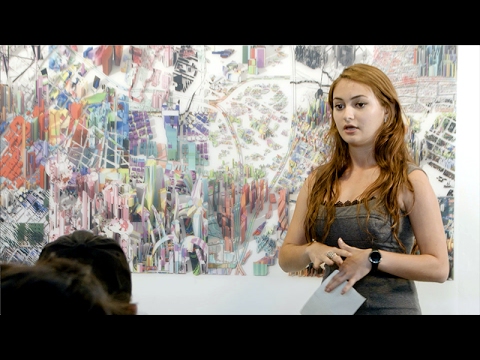
SCI-Arc’s Visual Studies Curriculum03:38
Courses in architectural representation help students turn design ideas into tangible artifacts that others can see, feel, understand, and appreciate. In this film, Anna Neimark, Visual Studies Coordinator at SCI-Arc, explains that VS seminars in representation provide students with the tools to make their ideas visible, translating intuitive thinking into a spatial language that can reach a broad audience.
Neimark describes an “all of the above” pedagogical approach that introduces students to an array of techniques in visualization: geometric line work, physical and digital modeling, material fabrication, scenic rendering and animation. In the core curriculum, students juggle software and workflows; they move deeper into select topics in elective seminars; and they author their own sequences of techniques in their thesis projects, developing bespoke recipes for fabrication and visualization.
The National Architecture Accrediting Board (NAAB) does not require schools to teach courses in visual studies, and many programs do not offer a curriculum dedicated to representation. But at SCI-Arc, VS seminars form the foundation of the design pedagogy, not because they are required, but because they expand the students’ creative potential.
SCI-Arc faculty agree that architectural thinking is an art form. They strive to create an experimental and technical environment at the school, guiding students to develop a unique voice and a creative approach to design.
©2026 SCI-Arc Channel
Related